

The Mezuzah: Identity marker, amulet, or reminder of the Law?
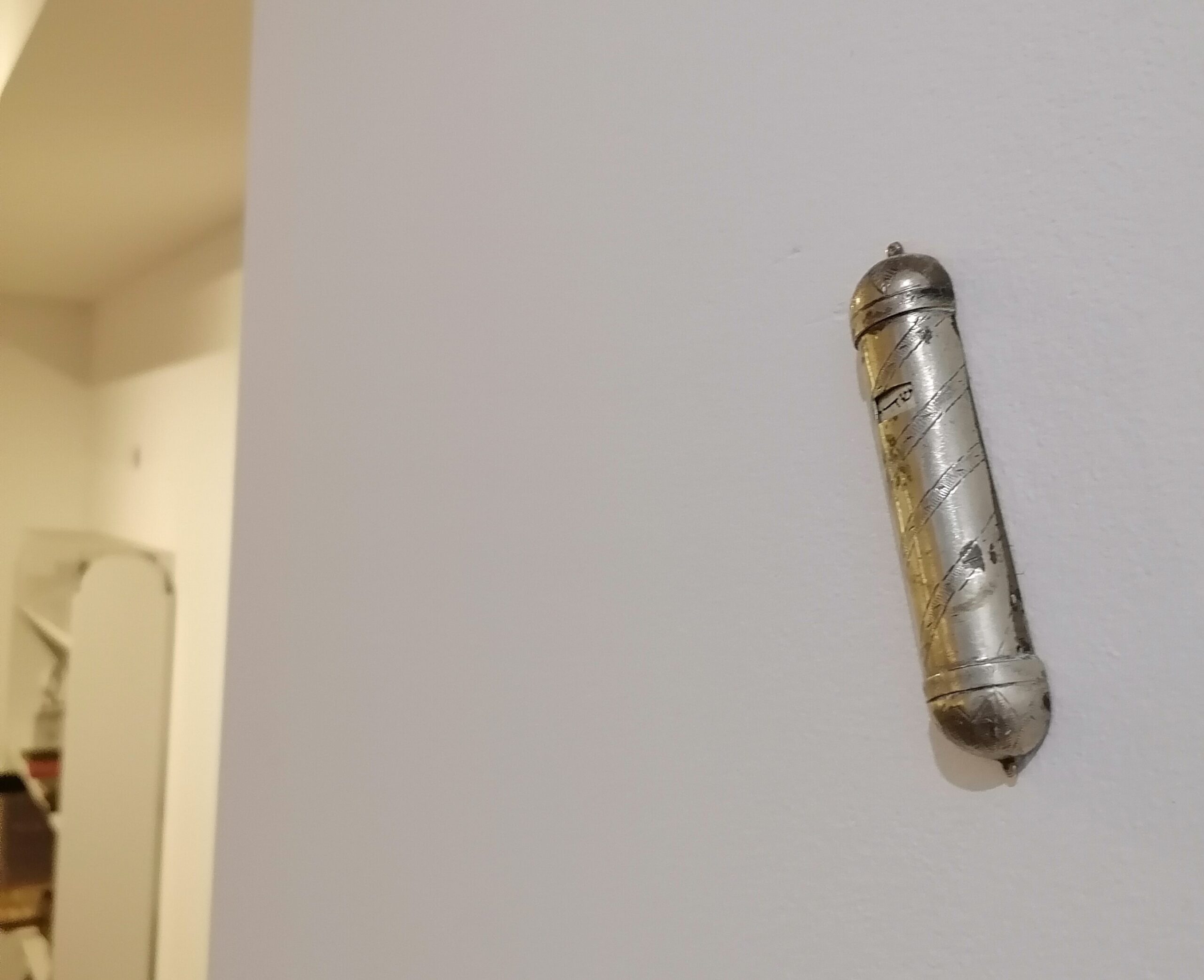
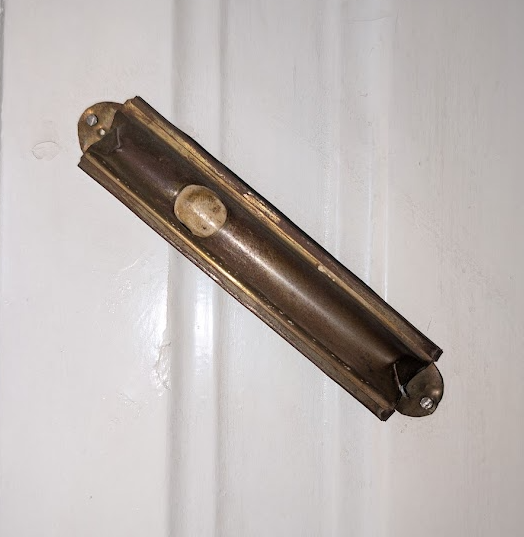
As visitors enter the first room of our museum, they immediately notice, on the right-hand side of the entrance, a peculiar object fixed to the wall. This is the Mezuzah. But what exactly is it? What was its purpose and how was it used? The following article seeks to answer these questions.
The Mezuzah is a small parchment scroll containing two passages from the Book of Deuteronomy (6:4–9 and 11:13–21). These texts read as follows:
“Hear, O Israel: The Lord is our God; the Lord is one. And you shall love the Lord, your God, with all your heart and with all your soul, and with all your means. And these words, which I command you this day, shall be upon your heart. And you shall teach them to your sons and speak of them when you sit in your house, and when you walk on the way, and when you lie down and when you rise up. And you shall bind them for a sign upon your hand, and they shall be for ornaments between your eyes. And you shall inscribe them upon the doorposts of your house and upon your gates.”
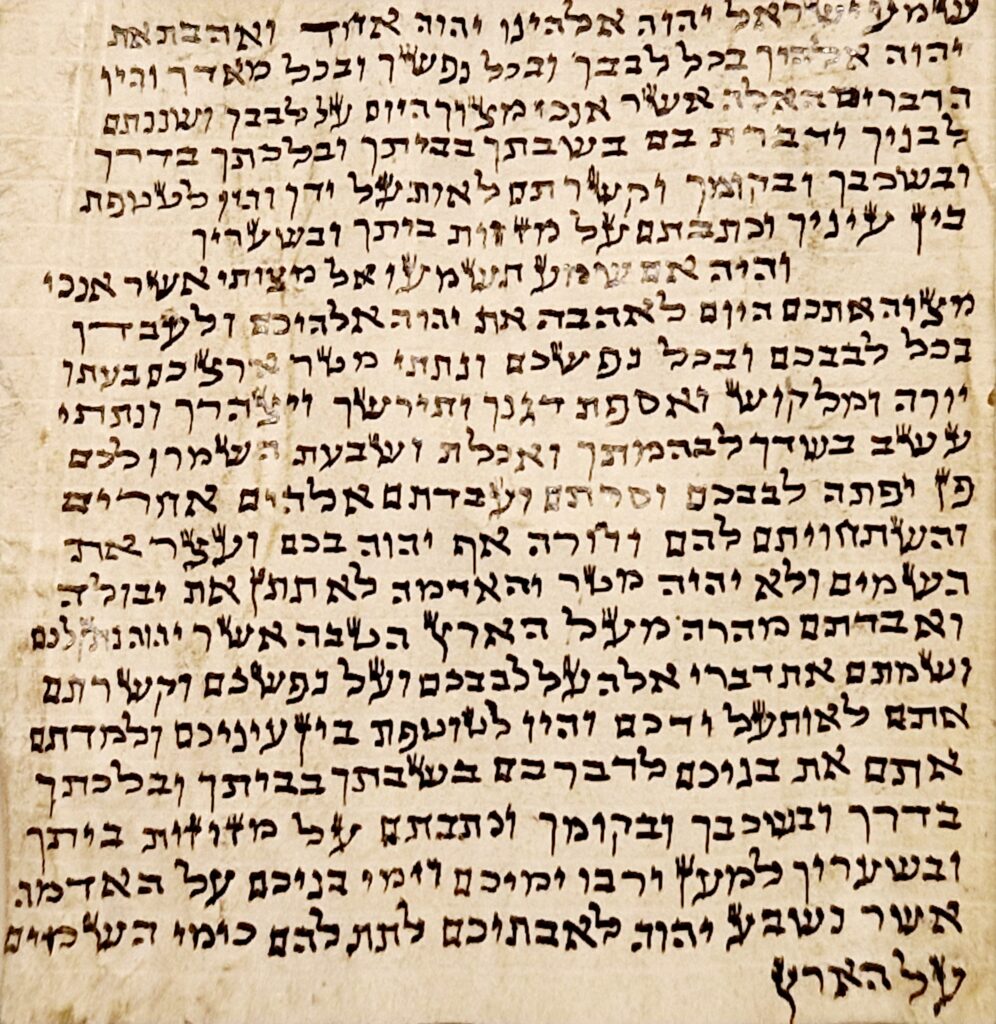
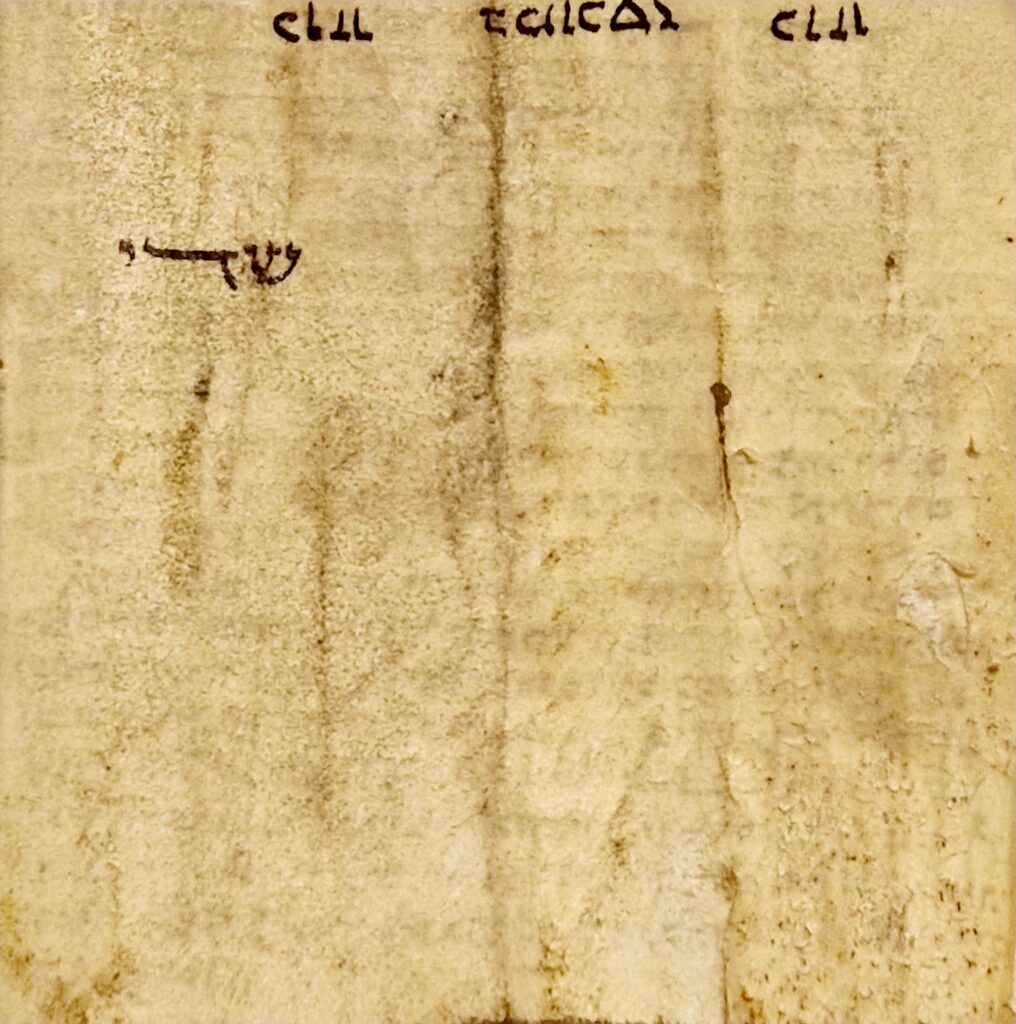
1-2. The mezuzah text (museum archive)
“And it will be, if you hearken to My commandments that I command you this day to love the Lord, your God, and to serve Him with all your heart and with all your soul, I will give the rain of your land at its time, the early rain and the latter rain, and you will gather in your grain, your wine, and your oil.And I will give grass in your field for your livestock, and you will eat and be sated.Beware, lest your heart be misled, and you turn away and worship strange gods and prostrate yourselves before them. And the wrath of the Lord will be kindled against you, and He will close off the heavens, and there will be no rain, and the ground will not give its produce, and you will perish quickly from upon the good land that the Lord gives you. And you shall set these words of Mine upon your heart and upon your soul, and bind them for a sign upon your hand and they shall be for ornaments between your eyes. And you shall teach them to your sons to speak with them, when you sit in your house and when you walk on the way and when you lie down and when you rise. And you shall inscribe them upon the doorposts of your house and upon your gates, in order that your days may increase and the days of your children, on the land which the Lord swore to your forefathers to give them, as the days of heaven above the earth.”
These passages must be written on parchment according to a strict structure: 22 lines, each line containing exactly 22 words. In biblical texts, the mezuzah includes specifications such as “doorposts” or “on your gates,” also indicating the physical place where it must be affixed. According to Ashkenazi tradition, the mezuzah must be attached to the right side of the doorpost (or doorframe), in the upper third, slightly tilted inward, towards the room, as a classic example of compromise between two differing opinions: Rashi, a rabbi from the 11th century, believed the mezuzah should be mounted vertically; his grandson, Rabbenu Tam, said it should be mounted horizontally because the commandments and Torah scrolls were positioned horizontally in the Ark and in the Temple. Eventually, one hundred and fifty years later, Rabbi Jacob Ben Asher suggested it be mounted at an angle, toward the interior of the room, to reconcile both interpretations of the same commandment (Sephardic and Mizrahi Jews mount their mezuzah in a vertical position).
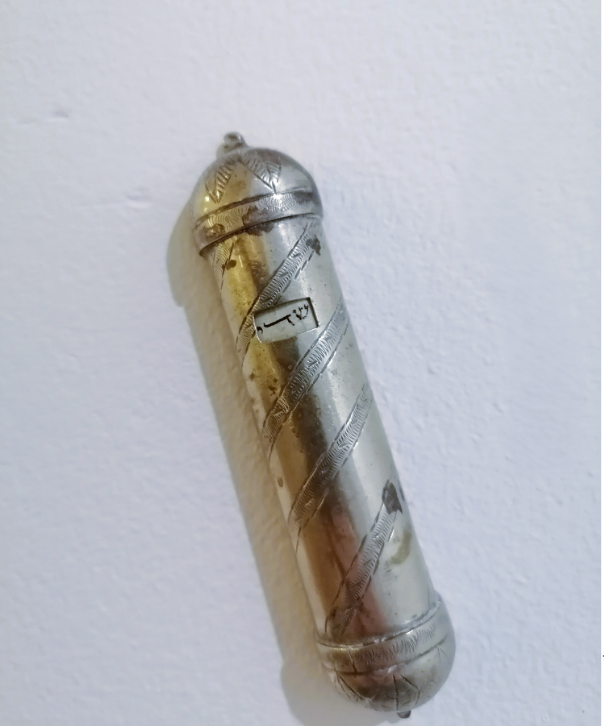
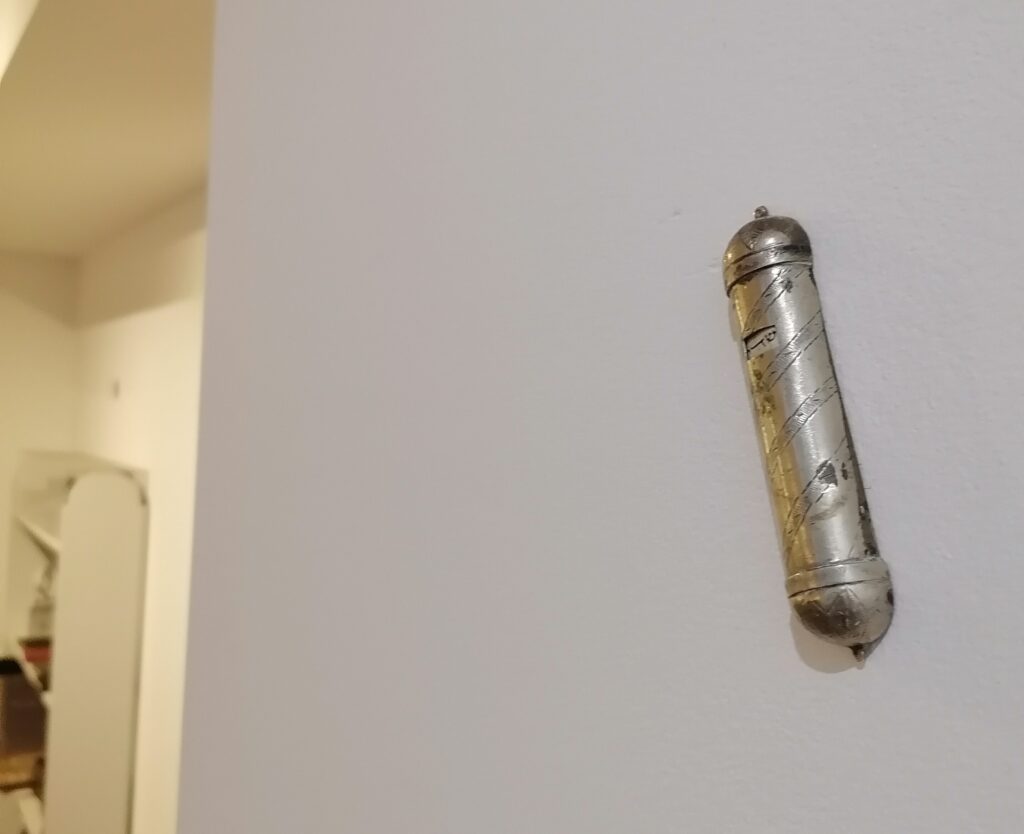
3-4. Mezuzah displayed in our museum
The Evolution of the Role of the Mezuzah in Jewish Tradition
In antiquity, its primary function was to remind the Jewish family living within the home of who their God was, how they were to worship Him, and to serve as a continual admonition to observe the divine commandments contained in the Torah.
During the rabbinic period (1st–7th centuries CE), however, the Mezuzah came to acquire an additional role as a protective and safeguarding symbol—a belief that continued into the Middle Ages. This development also has roots in antiquity: the doorway represented a threshold between two realms, marking the boundary between the home and the outside world, and thus served as a symbolic place of protection. One can even draw an analogy with the Passover ritual, when the blood of the lamb was smeared on the doorposts to protect the firstborn from death—a notion later echoed in the Mezuzah’s perceived protective power.
Similar to amulets, the Mezuzah began to be regarded as possessing protective, even magical, properties. Evidence for this can be found among Mezuzot discovered in the Cairo Geniza (a vast collection of Jewish manuscripts) where the margins of certain scrolls bear the names of angels. The renowned philosopher and rabbi Maimonides (1138–1204 CE) strongly criticized this practice, arguing that it degraded a sacred object meant to express the unity and love of God by turning it into a mere charm for selfish, superstitious purposes. Some communities even added divine names to the text, which provoked further rabbinic disapproval. This trend was particularly widespread in Ashkenazi (German) regions, and the Mezuzah remained a topic of heated rabbinic debate throughout the medieval period.
In contrast, modern liberal Judaism no longer views the Mezuzah primarily through the lens of its original religious or magical functions. Today, it often serves as an expression of Jewish identity, a visible marker of belonging and heritage.
As its meaning evolved, so too did its physical form. From Talmudic times onward, the parchment was kept in a protective case, leading to further discussions about how its decoration should reflect its sacred content. The most ornate Mezuzah cases date from the 18th century.
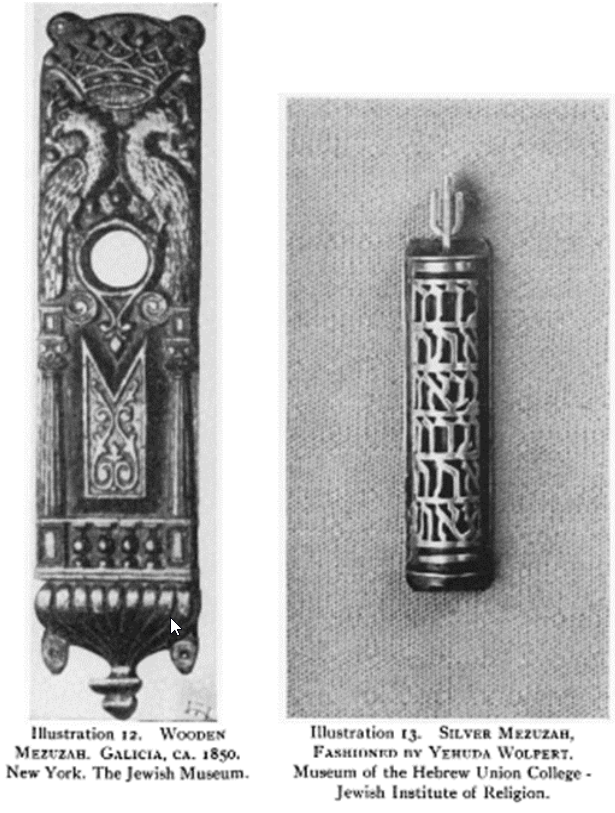
5. Decorated mezuzahs from the 19th century ( Franz Landsberger: 1960, 165 p.)
The case often has a small semicircular opening in its center, through which one of the names of G-d in Hebrew is visible: שַׁדַּי (Shaddai), which means “Almighty.” Interestingly, the same word – or just its first letter, שַׁ – also appears on the tefillin (phylacteries), which connects the two Jewish ritual objects.
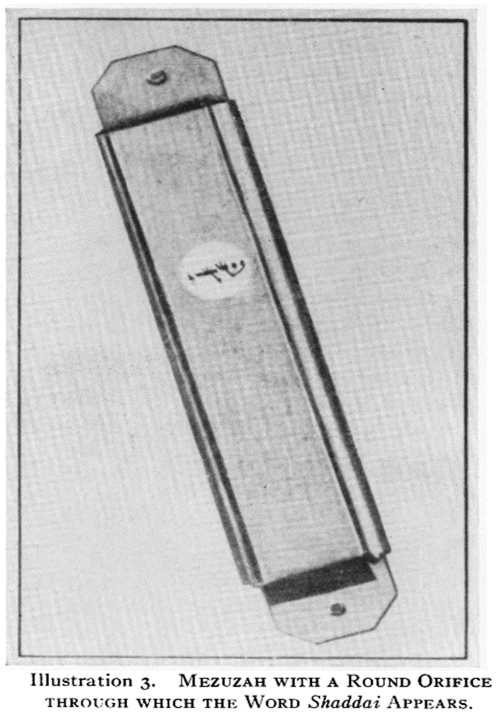
6. Through the round orifice, the Hebrew word Shaddai is visible.” (Franz Landberger: 1960, 155 p.)
Local mezuzot
The history of the building located at 25 Tipografiei Street in Cluj-Napoca, which is known for the mezuzot preserved on its doorframes, began in 1831 as a vacant lot near the city walls. Later, the space was transformed by Sámuel Pollák into the headquarter of his cement and asphalt factory. At the beginning of the 20th century, the building became the heart of the Autonomous Orthodox Israelite Community, serving various functions, from administrative offices to a ritual slaughterhouse and a bakery.
It survived economic crises and nationalization, the edifice entered a new stage in 2026, as it is set to be renovated to house our museum. In this building, which served as an essential administrative and religious center — first for the Autonomous Orthodox Israelite Community and, after the Holocaust, for the Jewish Community of Cluj — mezuzot have been preserved on several doorframes to this day. You can observe them in the images below:
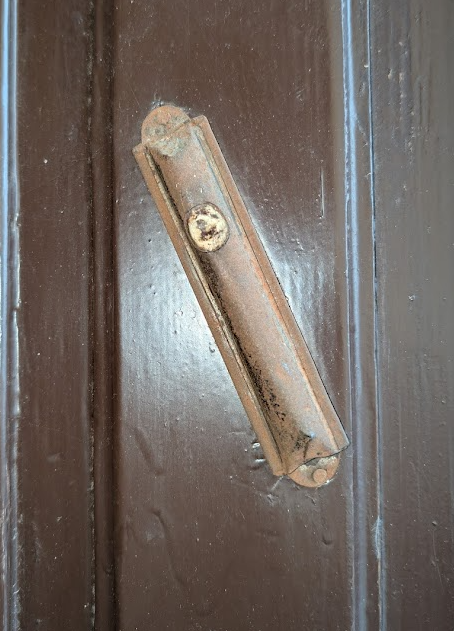
7-8. Mezuzot at 25 Tipografiei Street
Likewise our museum is enriched by a mezuzah, which can be seen on the wall of the first room; images of it can be found above, in this article.
The story of the Mezuzah is thus far richer and more complex than a casual museum visitor might suspect. It reveals much about Jewish religious life, culture, and historical continuity. Ultimately, we see how an object that began as a reminder of divine law gradually transformed through history into a symbol of identity.
Bibliography:
- Kitzur Shulchan Aruch. „Mezuzah rules” (https://zsido.com/fejezetek/a-mezuza-szabalyai/ )
- Kosior, Wojciech. “‘It Will Not Let the Destroying [One] Enter’ : The Mezuzah as an Apotropaic Device According to Biblical and Rabbinic Sources.” The Polish Journal of the Arts and Culture 9, no. 1 (2014): 127–44. (http://www.pjac.uj.edu.pl/documents/30601109/83f774ff-92d5-4a8e-9b7d-0cfbac755693)
- Landsberger, Franz. „The origin of the decorated mezuzah.” Hebrew Union College Annual 31 (1960): 149–166. http://www.jstor.org/stable/23506541.
- Méir Lau, Israel. Legile vieții evreiești. Ed. II‑a, Tel Aviv: 2000
- Schachter, Ilana. Mezuzah, A Reevaluation of its Text and Meaning for the Contemporary Jew. Los Angeles: Hebrew Union College‑Jewish Institute of Religion, School of Rabbinic Studies, 2012.
- Yisraeli, Oded. „The Mezuzah as an Amulet: Directions and Trends in the Zohar.” Jewish Studies Quarterly 22, no. 2 (2015): 137–161. http://www.jstor.org/stable/24752317.